— Fine Line · Guide
How does a fine line tattoo age? What fine lines really do over the years.
It's the most common question before a delicate tattoo: won't it blur over time? An honest answer needs no sales promise — just an understanding of what happens in the skin. This guide explains why a fine line can spread, which factors govern how it ages, and what makes it age well.
Why a fine line can spread
A tattoo is not a picture on the skin — it is pigment inside the skin. The craft lies in placing that pigment in exactly the right layer: deep enough that the skin holds it permanently, shallow enough that it doesn't scatter into softer layers. Between those two points there is only a tiny margin.
With a thick line, that margin forgives small imprecisions: there is so much pigment that a slight error barely shows. A fine line has no such reserve. Sit it too shallow and it fades, because the top layer of skin renews constantly. Sit it too deep and the pigment pushes sideways into softer layers — the line widens and blurs over the years. That is the spreading everyone worries about. It is rarely chance — it is usually a question of depth.
That's why the longevity of a fine line tattoo is decided long before you see any result — in the precision with which the needle is guided.
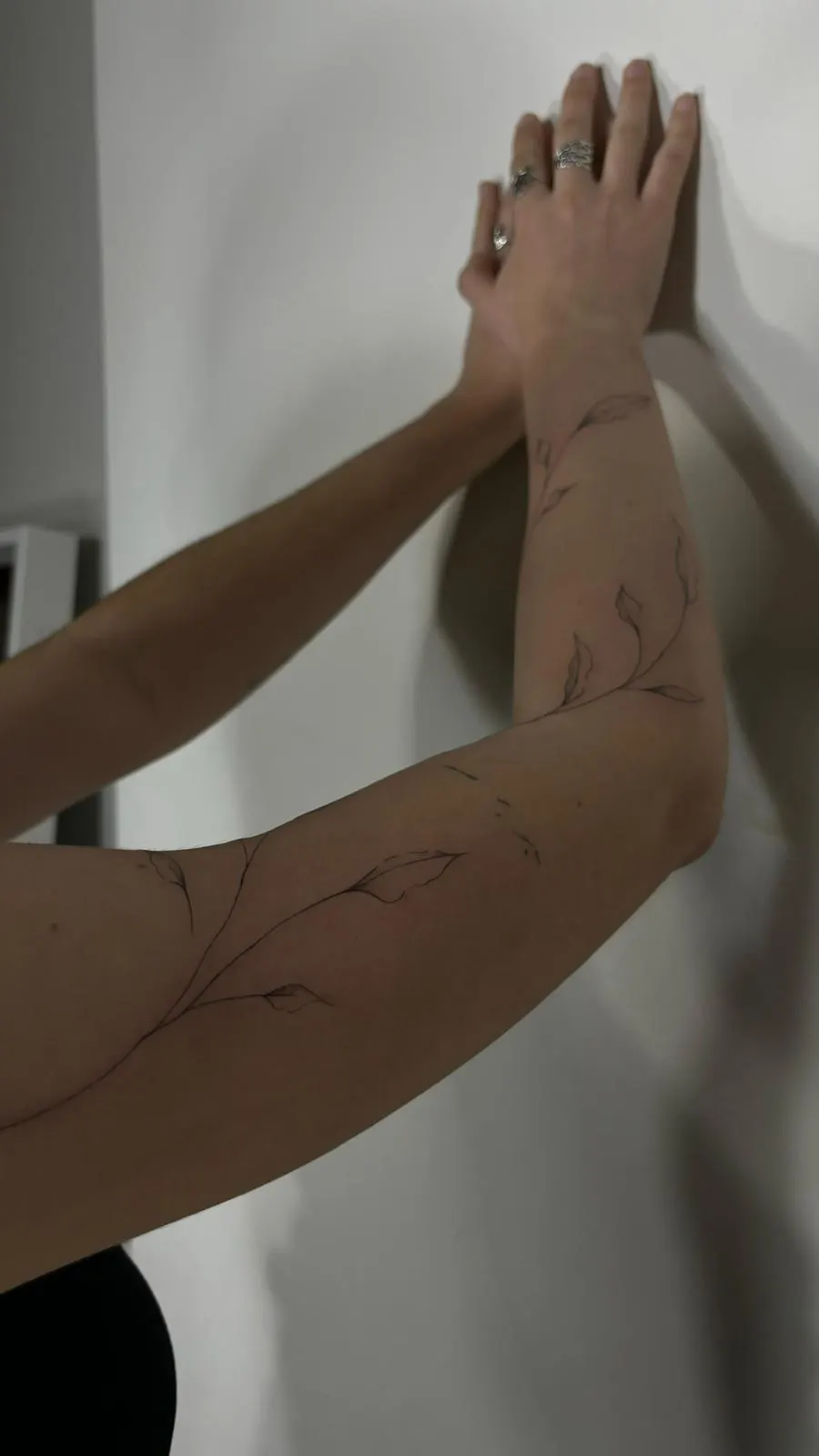
What determines the ageing
Six factors decide how a fine line looks over the years — some are on us, some are on you.
The depth of the needle
The most important factor — and the most invisible one. The pigment has to sit in a precise layer of skin. Too shallow, and the skin sheds it as it renews: the line fades. Too deep, and the pigment migrates into softer layers and spreads: a blowout. With a fine line there is almost no tolerance — the same imprecision a thick line forgives will make a thin one blurry.
The line weight
The thinner the line, the less pigment it holds — and the more the natural breakdown shows. Very fine details can merge over the years if they sit too close together. A fine line motif that ages well plans the spacing between lines from the start, so it stays readable ten years on.
The body location
Skin is not the same everywhere. Fingers, hands, feet and the inside of joints renew quickly and are constantly used — fine lines age fastest there. The forearm, upper arm, shoulder and back offer more stable, calmer surfaces where a fine line stays crisp for years.
Skin type & tone
Dry or thin skin holds pigment less stably; very stretchy or oily skin can make lines look softer. Skin tone also shapes how strongly the contrast reads over time. That is why we don't treat one motif like another — line weight and density are adapted to the skin that will carry them.
The sun
UV light is the greatest enemy of any tattoo, and it hits fine lines especially hard. Sun breaks pigment down and fades contrast. A tattoo regularly left unprotected in the sun ages years faster. Consistent sun protection is the simplest and most effective way to keep a fine line clear.
The aftercare
The result isn't made on the day of the appointment — it's made as the tattoo heals. How you care for the fresh work in the first weeks — moisture, protection, no friction, no scratching the crust — helps decide how evenly the pigment settles into the skin.
What makes a fine line tattoo age well
A motif ages well when three things come together: a precise, even depth as it's tattooed; a design built for time from the start; and skin that is protected and cared for.
Good design here often means restraint. A detail a touch larger, the gap between two lines a touch wider, a motif on a calmer area rather than a high-wear finger — decisions you barely notice on day one. You see them years later, when the tattoo still looks clear and quiet instead of merged. That is exactly what we think ahead to: not the photo at the end of the appointment, but the healed result years on.
And honesty is part of it. Sometimes ageing well means suggesting a very small, dense motif be made slightly larger — or advising against a placement that would fade fast. That is not a limitation; it is responsibility for something meant to last.
Why touch-ups matter
Even with perfect technique, skin doesn't take pigment evenly everywhere as it heals. A single spot can heal lighter than the rest — that is the nature of skin, not a fault. Only once the tattoo is fully healed does it show how the skin has truly accepted it.
That's why a check-up is so valuable with fine lines. It is the moment to refine, precisely, whatever healing made uneven — and to bring a fine line back to the clarity it was meant to have. A touch-up is not an admission; it is part of a careful process.
Fine line is our only discipline — and we think about the whole life of the line.
At Sinkply in Zürich we tattoo fine line exclusively. We work towards the depth that keeps a fine line clear, review the healed result within the first year, and offer free touch-ups. Send us your idea — we'll tell you honestly how it will age over time.
Instagram: @aroatattooist · @sinkply.zurich
Frequently asked questions about how fine line ages
Does a fine line tattoo blur over time? +
A fine line can widen slightly over the years — that is what people call blurring or spreading. The deciding factor is the depth at which the pigment sits: too shallow and it fades, too deep and the line pushes into softer layers and loses its edge. Placed at the correct depth, a fine line stays clear for years and ages in a controlled way. A slight softening of the edges is natural for any tattoo.
How long does a fine line tattoo last? +
A fine line tattoo placed cleanly at the correct depth stays clearly readable for many years. It ages like any tattoo, but because it holds less pigment it is more sensitive to sun, placement and aftercare. There is no honest single number — the range is wide and depends on each of those factors.
What role does the body location play? +
A large one. Areas with a lot of friction and movement — fingers, hands, feet, the inside of the wrists — age noticeably faster because the skin there renews and is stressed constantly. Calmer areas with stable skin such as the forearm, upper arm, shoulder or back keep fine lines crisp the longest.
Why do thin lines fade faster than thick ones? +
A thin line simply holds less pigment. The natural breakdown from UV light and cell renewal weighs more heavily when there is little pigment to begin with — the contrast drops off sooner. That is exactly why precision matters so much in fine line: there is no pigment reserve to hide a mistake in depth.
How does my skin type affect ageing? +
Dry, thin or sun-damaged skin holds pigment less stably; very oily or very stretchy skin can make fine lines look softer over time. Skin tone also affects the perceived contrast. An experienced eye adapts line weight and motif density to the individual skin, rather than treating every design the same.
Are touch-ups normal with fine line? +
Yes. With fine lines especially, a touch-up after healing is part of a careful process, not a sign of a mistake. As the skin heals, a single spot can take pigment unevenly. A check-up within the first year shows how the skin has truly accepted the motif — and that is precisely when a line can be refined where needed.