Fine Line vs. Traditional Tattoo — Needles, Aging, Style Compared
Fine line vs. traditional tattoo head to head. Needle gauge, depth, aging over the years, aesthetic and who each style is made for — from the perspective of a Zürich fine line studio.
At first glance across a portfolio, it’s obvious: some tattoos look like they were drawn with a Japanese ink pen, others painted with a wide brush. It’s not just taste — they’re two fundamentally different approaches to the same art form. Fine line and traditional differ in needle gauge, depth, aging behaviour, session length, and often also in the people who wear them.
This guide explains where the real technical differences lie, how both styles age over ten years, which motifs work better in which style, and who each path is made for. From the perspective of a fine line studio in Zürich — with the respect traditional deserves.
What is fine line, what is traditional?
Before comparing, a quick positioning.
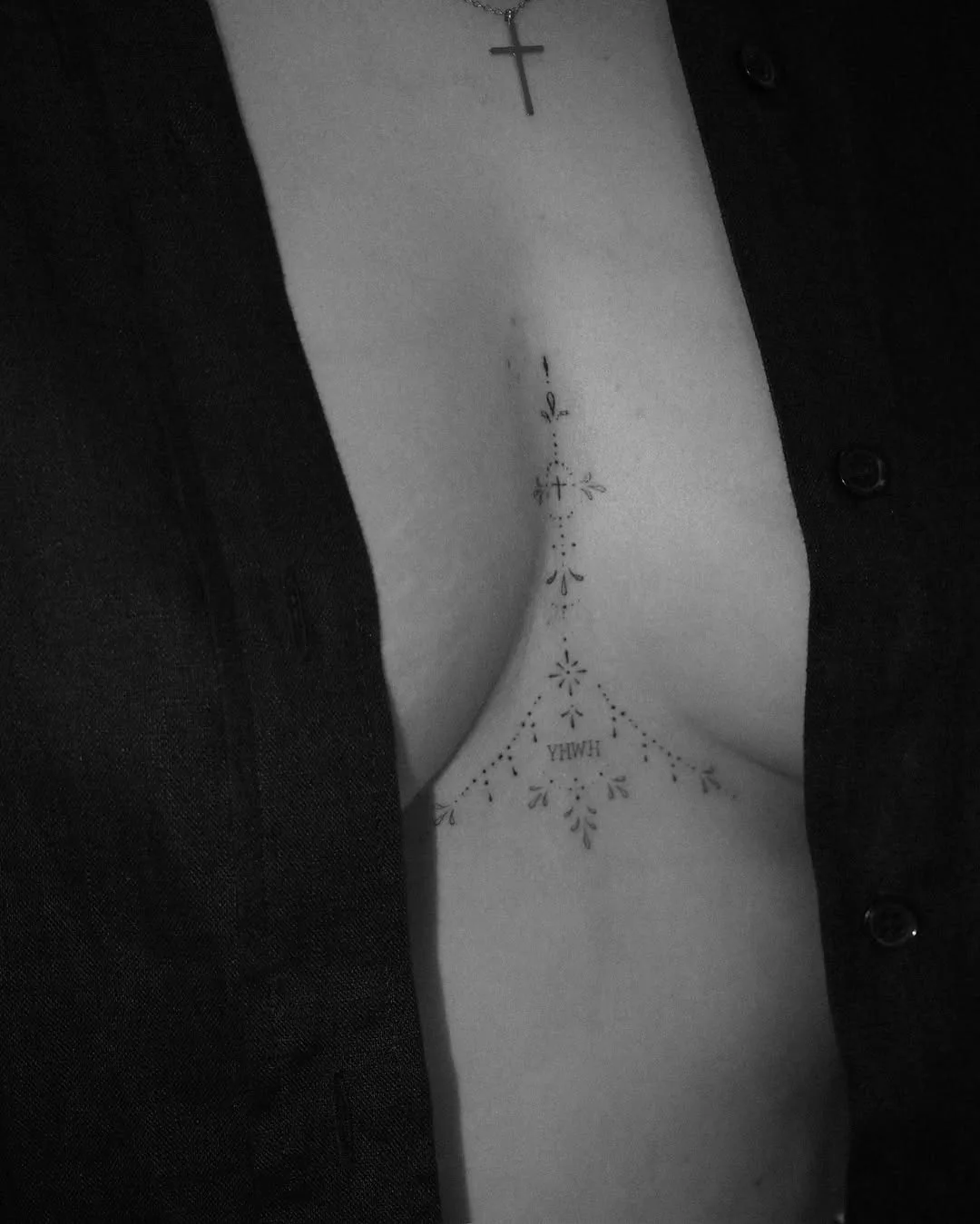
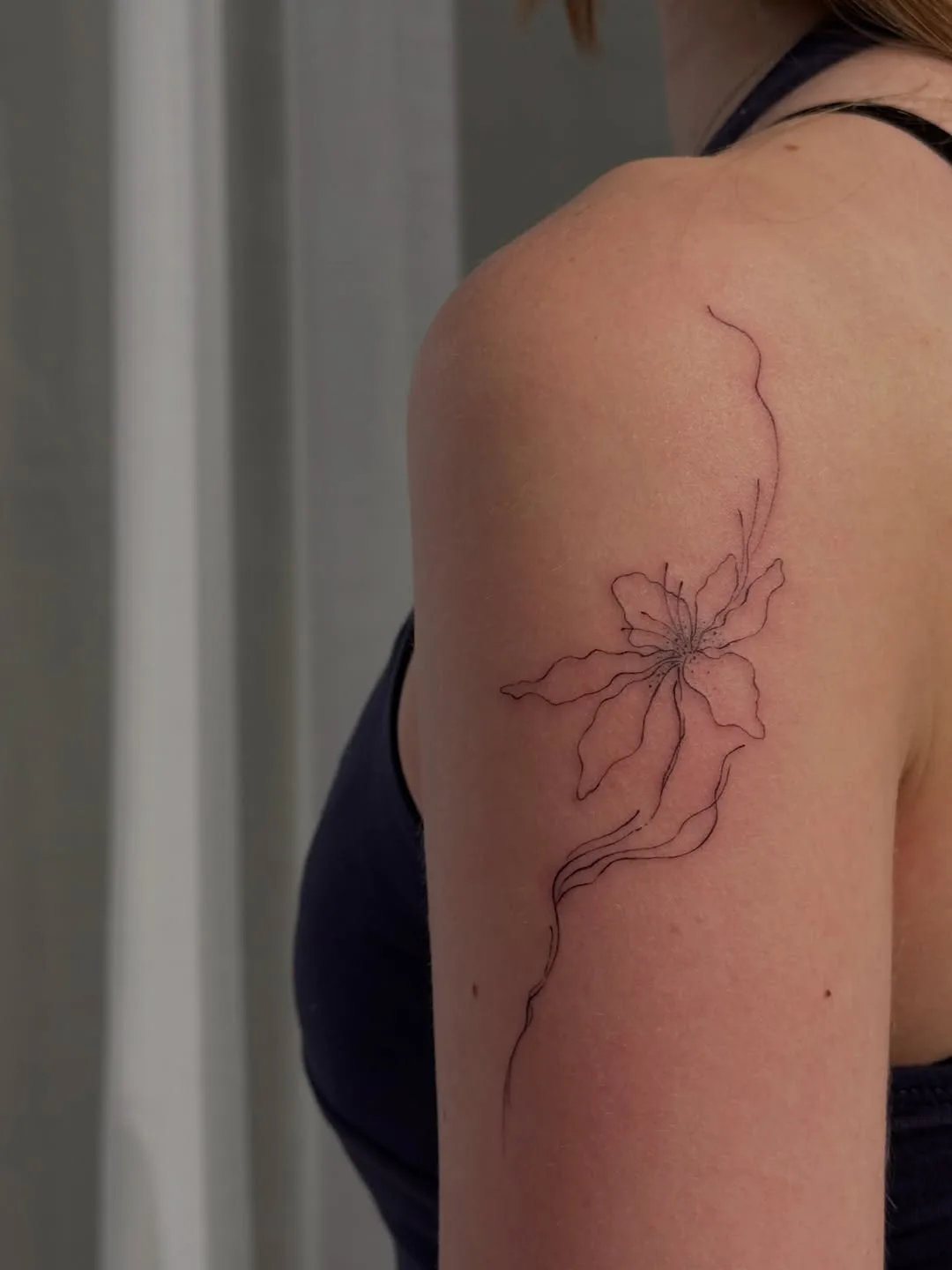
Fine line tattoo is a relatively young style that became popular in the last ten to fifteen years, especially in Los Angeles, New York, Tokyo and Zürich. It works with thin lines, lots of white space, minimal shading and photographically precise drawing. Typical motifs: botanicals, lettering, mini symbols, silhouettes, delicate ornamental work.
Traditional tattoo (also American Traditional, Old School, or in the broader sense Realism and Japanese) is the classic style — Sailor Jerry, Ed Hardy, the tradition that came out of 20th-century port cities. Thick lines, saturated colours, lots of black, fully packed fields. Typical motifs: swallows, anchors, roses, skulls, pin-ups, Japanese dragons.
In between are many hybrids — Neo-Traditional, Illustrative, Blackwork — but for a direct comparison we’ll focus on the two poles.
Needles — the technical difference no one sees
This is the core of the matter, and most clients don’t know it.
Fine line needles:
- Single needle (1RL) — one single needle, hair-thin
- 3RL or 3-round liner — three needles in a tight bundle
- Total diameter at the skin surface: 0.25 to 0.35 mm
Pigment is deposited in a single, precise pass. The line is as thin as a pencil line on paper. Each line is gone over only once — the focus is sharpness, not saturation.
Traditional needles:
- 7RL to 13RL — bundles of seven to thirteen needles for thicker lines
- Magnum (M1, M2) — flat bundles of 9 to 21 needles for filling
- Round shader — dense needle groupings for shading
- Total diameter at the skin surface: 0.8 to 2 mm
Pigment is applied in multiple layers. Each line is gone over several times to build the depth and saturation that define a classic piece.
The consequences:
- Fine line traumatizes the skin significantly less
- Traditional carries more pigment per area (higher long-term saturation)
- Fine line heals faster (7 to 10 days)
- Traditional takes longer to heal (14 to 21 days)
- Fine line is unforgiving in execution — any wobble shows
- Traditional forgives small inaccuracies because the lines are thicker
Depth — one millimetre decides everything
Both styles tattoo into the same skin layer: the upper dermis, roughly 1.5 to 2 millimetres below the surface. But:
Fine line goes into the uppermost layer of the dermis. Pigment deposit is shallow and concentrated. This makes the line razor-sharp and allows precise detail. It also means the tattoo fades slightly faster over the years because the pigment sits closer to the regenerating epidermis.
Traditional goes deeper into the dermis. Pigment sits more stably, distributes across more tissue layers and stays intact for decades.
The difference is subtle but visible over ten to twenty years. And it’s why your 85-year-old neighbour can still read his 1958 sailor anchor clearly — while the first fine line piece someone got in 2015 may need a touch-up by 2040.
Aging — the honest long-term comparison
This is the question that comes up before every first tattoo: what does this look like in twenty years?
Fine line after 5 years: Still very sharp. Maybe marginally softer in the lines. With consistent UV protection you’d barely notice.
Fine line after 10 years: Visible change. Lines look slightly softer, some very fine details (like individual pollen dots) can disappear. Overall composition remains readable, especially with well-kept skin. In many cases after 10 to 12 years a refresh makes sense — half a session redrawing the key lines.
Fine line after 20 years: Distinct softening. The gap between very thin and very thick lines disappears. The piece is still beautiful but matured — similar to a black print on aged paper.
Traditional after 5 years: Practically unchanged if UV protection is kept up.
Traditional after 10 years: Minimal fading, but contours stay very stable. Black fields stay black.
Traditional after 20 years: The classic “blurred-but-beautiful” look. Lines soften slightly, colours deepen. That aging is part of the aesthetic and in traditional it’s often celebrated rather than regretted.
What affects aging more than the style:
- UV exposure — every tattoo’s biggest enemy
- Skin quality and hydration across the years
- Weight fluctuations and skin stretching (belly, thigh, chest)
- Friction from sport or profession over time
Aesthetics — which style fits which motif
Not every motif works equally in every style. An honest pairing.
Motifs that work brilliantly in fine line:
- Delicate botanicals and blooms
- Handwriting-style lettering
- Mini symbols (star, moon, cross, heart)
- Photographic pet portraits
- Delicate ornamental patterns
- Single-line compositions
- Small, intimate pieces
Motifs that work brilliantly in traditional:
- Large-scale compositions (half-sleeve, back piece)
- Bold symbolism (anchors, skulls, flames)
- Pin-ups and figure studies
- Japanese motifs (koi, dragons, classic-form cherry blossoms)
- Anything that demands colour and visual force
- Pieces that should read from three metres away
The fine line pet portrait we do with Jon would be almost impossible in traditional — the brushstroke realism needs the thin needle. Conversely, a classic koi arm in fine line would feel visually weak — the power of the motif needs thick lines and packed fields.
More about our fine line style in Zürich here.
Session length and price
Fine line:
- Mini piece: 30 minutes to 1 hour
- Medium piece: 1.5 to 3 hours
- Large piece: 3 to 5 hours in one session, otherwise split
Traditional:
- Mini piece (rare, because the style leans away from it): 1 to 1.5 hours
- Medium piece: 3 to 5 hours
- Large piece: multiple sessions of 4 to 6 hours
On price it’s similar: for the same size, traditional is often 20 to 40 percent more expensive because more time per square centimetre is needed. At our Zürich pricing, a mini fine line runs CHF 150 to 220; a comparable traditional piece tends to start at CHF 200 to 280.
Who each style is made for
No moral ranking — two different languages that can say the same sentence.
Fine line is made for you if:
- You want a discreet, detailed piece
- You love a photographic or craft-precise look
- Your lifestyle makes long healing phases hard
- You’re in a work environment where discretion matters
- You see the tattoo as an intimate extension of your skin, not a statement
- You’re okay with the slightly faster aging as a trade-off
Traditional is made for you if:
- You want a powerful, instantly readable statement
- You’re planning large-scale compositions (sleeve, back piece)
- You’re betting on longevity and stable colour impact over decades
- You love classic tattoo culture and want to belong to it
- You have robust skin that processes larger trauma well
- You’re not afraid of longer sessions and healing times
There are also people who combine both styles across a lifetime — a fine line botanical on the forearm, a traditional koi on the thigh. That’s not inconsistency; it’s a very natural evolution.
Can both styles be combined?
Yes, but carefully. Side by side on the same body — no problem, different body areas or with clear space between. Directly inside each other — difficult. A fine line detail inside a traditional piece often loses its finesse, and a thick traditional line in a fine line piece looks out of place.
If you want both, plan them as two projects, not one. If in doubt: start with fine line, because it’s easier to add a traditional piece later than the reverse.
The short decision aid
If after reading you’re still unsure, here are the two questions that lead most people to the right style:
-
Picturing yourself in 20 years — do you wear a piece that stands out, or one that’s personally close to you? Stand out = traditional. Personally close = fine line.
-
Are you someone who values handwritten letters, or someone who values printed posters? Letters = fine line. Posters = traditional.
Both answers are right. Art doesn’t work in right or wrong — only in fitting or unfitting.
Consultation before you decide
In our Zürich studio we work exclusively in the fine line space — Aroa as founder, Jon for pet portraits. If you’re unsure whether your project really fits fine line or would be better placed with a traditional-specialised artist, we’ll tell you honestly. We know the studios in Zürich that excel in the classic style, and we refer on when it’s a better fit for you.
Message us on WhatsApp at +41 77 212 07 67 or on Instagram @sinkply.zurich. A short consultation and we’ll tell you honestly whether fine line is your style — or isn’t.
Staffelstrasse 8, 8045 Zürich.
— Written by
Aroa, founder of Sinkply Zürich. Specialised in fine line and abstract flowers since 2019.
— Keep reading