Dog Portrait Tattoo in Zürich — breed, expression and fur texture in fine line
Dog portrait tattoo in Zürich. Breed-specific detail (Bulldog, Labrador, Hovawart, mix), eyes as the core, fur texture in fine line. Drawn by Jon.
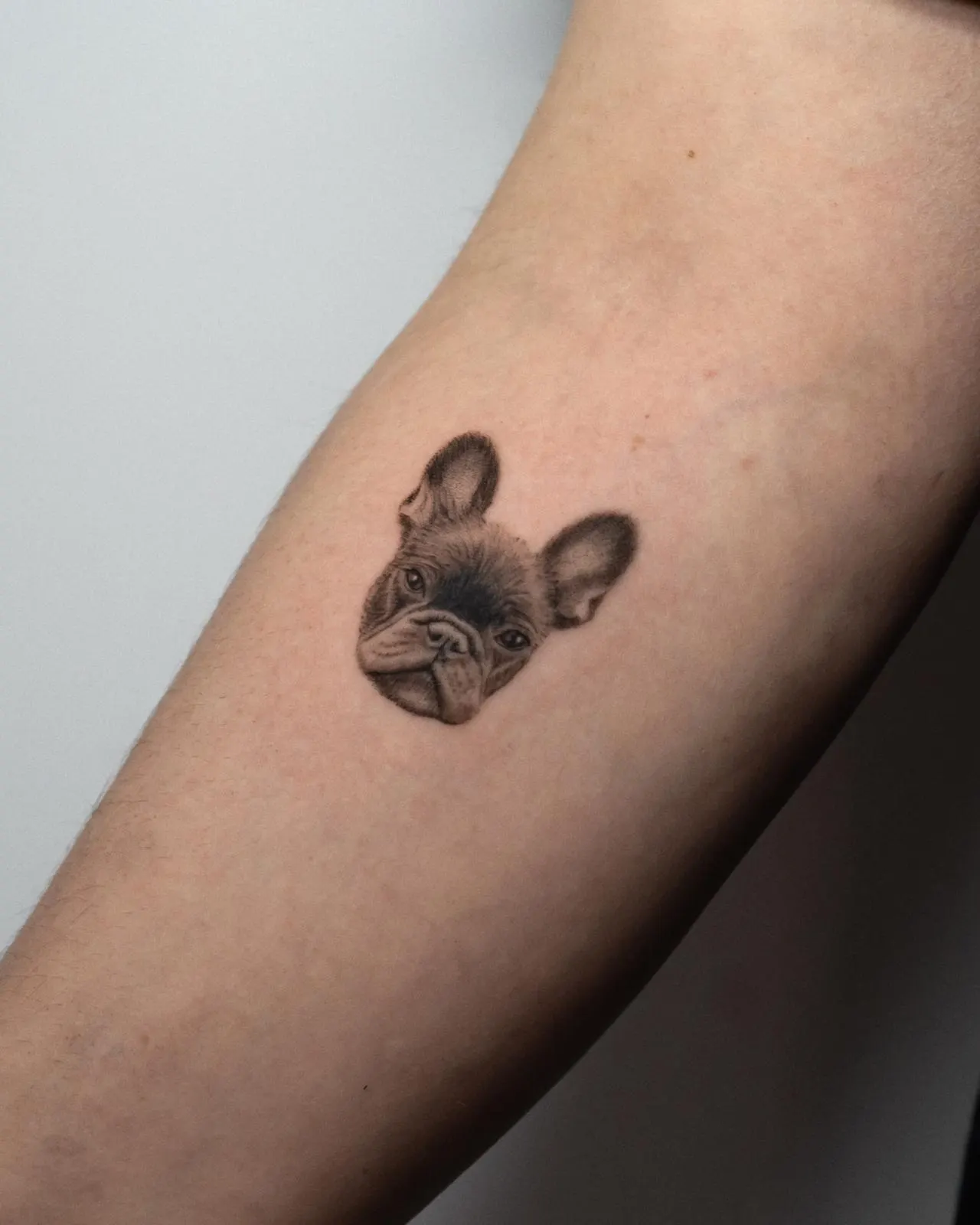
Of all the animals I put on skin — cats, horses, rabbits, the occasional guinea pig — dogs are by far the most common. Roughly six out of ten pet portraits that leave our Zürich studio are dogs. Each breed brings its own challenges. A French Bulldog doesn’t tattoo like a Labrador; a Hovawart doesn’t tattoo like a mixed breed. This article walks through the specifics of the breeds we most often do at Sinkply — and shows you what to watch for with your own dog portrait. I’m Jon, the pet portrait specialist at the studio.
The eyes carry the whole piece
Before we get into breeds: on every dog portrait, the eyes are the central element. Not the fur, not the nose, not the posture — the eyes. They decide whether the viewer recognises your dog or just sees “some brown dog”. For that reason I need sharp eyes in your reference photos; everything else can be blurry, partially cropped or shot from a less-than-ideal angle. The pupil, the light reflex, the eye colour and — most importantly — the expression: sadness, curiosity, alertness, calm. Those are the micro-details that separate your dog from every other dog.
In practice that means: the eye on the tattoo needs to be at least 6 to 8 mm across so the pupil and the light reflex can be placed cleanly. At portrait sizes under 5 cm the eyes merge into a flat field — no photo, however detailed, saves that. If you want a dog portrait, plan on a minimum size of 8 cm. I don’t recommend going smaller.
French Bulldog
Bulldogs are the breed we tattoo most often. Their signature: short coat, strong facial folds, big eyes, often striking coat contrasts (black and white, grey and white, fawn with a black mask). For the tattoo that means:
- The folds around the muzzle need to be clearly placed — without them the bulldog looks like a pug or a Boston Terrier
- The eye socket is deep; the light reflex matters especially here, otherwise the eyes read as “empty”
- The signature bat-ear stance is instantly recognisable — a photo showing the ears straight on almost always works
- Short fur means less texture work but more shading for volume
Ideal size: 8 to 12 cm on the forearm, one session of 4 to 5 hours. Bulldogs also work well as mini-portraits from 6 cm because the large eyes take up a lot of the head.
Labrador and Golden Retriever
The family of long-haired, evenly-coloured dogs. The big challenge here: setting the fur in fine line so it doesn’t read as a solid field. A single-colour Labrador (black, chocolate, cream) has almost no natural contrast — the texture has to be built purely with line direction and fine shading.
What I need for Labradors:
- A photo with side light, ideally outdoors in shade or in front of a window. That creates the micro-contrasts that make the fur look three-dimensional
- The classic head tilt (“Are-you-talking-to-me?” look) — a recognisable Labrador detail
- Details like the flews (the hanging lips) and the folds at the corners of the mouth
Size: preferably 10 to 14 cm on the upper or lower arm. Under 10 cm the fur texture becomes too compact and the dog looks “smooth” — not like a retriever. One session is usually enough at 10 cm; at 14 cm plan for two.
Hovawart, German Shepherd and other large guardian breeds
This group brings dense fur texture, strong colour gradients (black-and-tan on the Shepherd, black-and-gold on the Hovawart) and often upright ears. Technically that’s the best starting point for fine line — lots of natural texture to work with, clear contrasts, readable head outline.
Specifics:
- The fur direction varies strongly between forehead, cheeks and neck — I work with different line orientations so the fur structure “breathes”
- Upright ears are a trademark of these breeds — they must never be squashed or cropped
- The area around the eyes is often dark; I deliberately place light-reflex points to lift the eyes out of the surrounding shading
Size: these dogs need room. I recommend at least 12 cm, ideally 14 to 18 cm on the shoulder blade, upper arm or thigh. For large breeds with heavy muzzles a too-small portrait never looks right.
Mixed breed — the most common case
Most of our clients have a mixed breed. These are my favourite projects because there’s no “template”. Every mix is a one-off: collie ears, spaniel muzzle, terrier fur. I can’t draw “the mix” — I have to draw your mix.
What that means for you:
- Send me more photos than you would for a pure breed. At least five, ideally eight to ten. The micro-details that make your dog your dog aren’t predictable
- Tell me in one sentence what’s “typical him”. “He tilts his head when he listens.” Those details feed into the composition
- Tell me which parent dominates visually if you know. “More Labrador in the head, more Husky in the coat” — that helps me weight the details
Size: flexible, 8 to 18 cm. Mixes work at all sizes as long as the eyes have enough room.
Puppy vs adult dog
A frequent question: “Should I get a portrait of my dog as a puppy or as an adult?” My honest answer: take the age where you see him most strongly. If he’s still the puppy in the basket for you — do the puppy. If he’s the calm older dog by your side — do the older dog.
Technically the difference matters:
- Puppy: softer facial features, larger eyes relative to the head, shorter fur, often more shading needed to convey the softness
- Adult: clearer proportions, more defined bone structure, clearer fur texture, calmer expression
- Senior: grey fur around the muzzle, often slightly cloudier eyes, sometimes drooping flews. Those are details that characterise the dog — we don’t draw them out, we work them in
Size, placement and number of sessions
A quick reference for dog portraits:
- 6 to 8 cm — only for small, high-contrast breeds (Bulldog, Chihuahua with lots of eye area). Wrist, inner forearm. One session, 3 to 4 hours.
- 8 to 12 cm — the classic for mid-size breeds. Forearm, upper arm. One session, 4 to 5 hours.
- 12 to 18 cm — for large breeds or dense texture. Shoulder blade, upper arm, thigh. One to two sessions.
- 18 to 22 cm — whole body or dog plus a background element. Thigh or back. Two to three sessions.
For a very small dog on a delicate placement — a Chihuahua as a mini-portrait on the wrist, for example — also read our guide to mini tattoos in Zürich. That one covers the technical limit — how small fine line can go without losing detail.
Multiple dogs in one tattoo
Double and triple portraits are above-average common with dog people — a current dog with a deceased one, two siblings, or the classic “my two boys”. We always draw these as a coherent composition, never as two separate portraits placed side by side. The heads sit at angles to each other, the shoulders overlap slightly, sometimes one paw touches the other dog. That creates closeness instead of a list.
For a double portrait plan on at least 12 cm in width and a session of 5 to 6 hours, often split across two appointments. Price: from CHF 900, depending on size and detail density.
Ready to send photos
If after this article you have a sense of what you want — message me photos of your dog via WhatsApp at +41 77 212 07 67. Five photos, name, rough size, placement. I’ll reply within 48 hours with an estimate.
More on the overall workflow on the Pet Portrait Tattoo Zürich main page. Ongoing portfolio on Instagram: @jontattooist.
— Written by
Aroa, founder of Sinkply Zürich. Specialised in fine line and abstract flowers since 2019.
— Keep reading